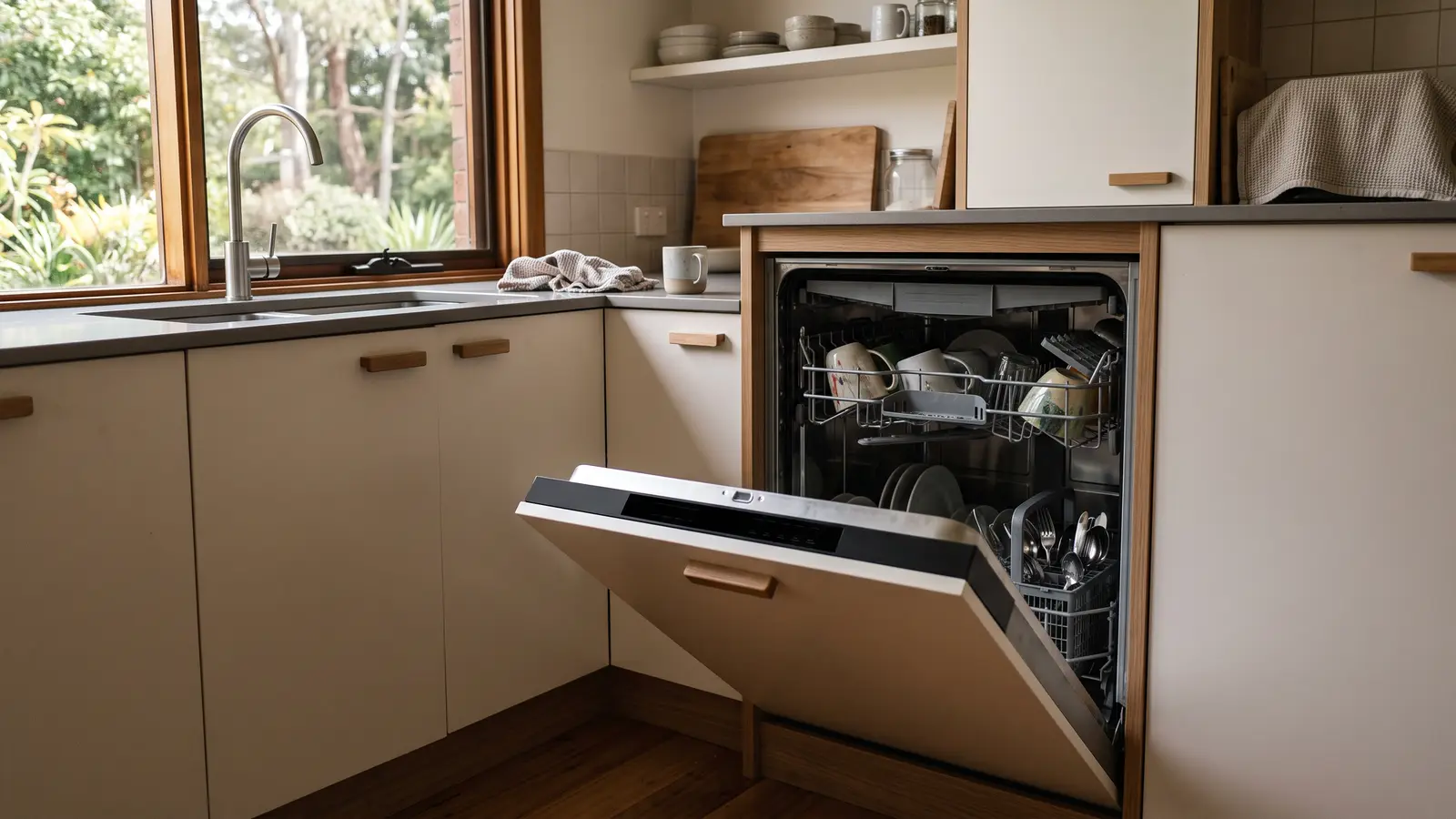
A dishwasher that won't start at all almost always comes down to one of four things: no power reaching it, a door that isn't registering shut, a delay-start left running from the last load, or a flood-protection lockout doing exactly what it's meant to. Work through them in that order, because each one rules out the next, and the first three don't need a technician.
Start with the power, not the machine
A dishwasher that shows nothing at all isn't necessarily faulty. It might just not be getting power.
Check the powerpoint first. If the dishwasher is on a switched outlet under the sink or in the cupboard next to it, that switch gets bumped or turned off during a clean-out more often than people admit, and it's the single most common reason we get called to a machine that is perfectly fine once we look. If the machine shares a circuit with the kitchen safety switch, and something else in the house has tripped it, the dishwasher will be just as dead as everything else on that circuit. I've written about what actually trips a safety switch and why resetting it without finding the cause doesn't hold, which is worth a look if the switch keeps going.
If there's a double adapter or a powerboard involved, pull it out and plug the dishwasher straight into the wall. A loaded powerboard behind a cabinet is an easy thing to overlook, and it's not somewhere anyone checks first.
The door has to click, not just close
Every dishwasher has a catch that confirms the door is properly shut before it will let a cycle run. It's a safety interlock, the same idea as the lid switch on a top loader, and on a machine that's a few years old the catch or the striker plate it grabs can wear enough that the door looks shut but isn't quite registering.
Push the door firmly until you hear or feel a positive click, not just a soft close. On integrated dishwashers behind a cabinet door, check that the cabinet panel itself isn't sitting slightly proud and holding the actual dishwasher door a few millimetres open. That's common enough on a kitchen that's had the toe kick or the panel adjusted for any reason, and it produces exactly this fault.
Check the display for a delay start
A dishwasher that looks completely dead can be one that's simply set to start later. A delay-start function left on from the last load, or bumped by a hand reaching past the panel, will sit there showing a countdown or a small icon that's easy to miss if you're not looking for it.
Hold the delay button, if there is one, and see whether a number appears and counts down. On some machines it's a small light rather than a number. If the panel has nothing lit on it at all, that rules this one out and points back at power.
Check for a child lock at the same time. Most machines show a small padlock symbol when it's active, and getting it off usually means holding two buttons together for a few seconds. The manual that came with the machine, or a search on the model number, will have the exact combination if it isn't printed on the panel itself.
Some dishwashers hum instead of staying silent
A machine that hums, or runs its drain pump on its own without a cycle having been started, isn't dead the way a silent one is. That's usually flood protection doing its job rather than failing.
Most dishwashers built in the last couple of decades have a small catch tray underneath with a float resting in it, and once water reaches that float, the control board cuts the cycle rather than let the pump keep working against a leak it has no way of seeing. Bosch machines are particularly common around here and use exactly this system. I've gone into more detail on how that lockout behaves on a Bosch, because clearing the tray gets the machine running again without telling you where the water came from, and it's worth reading before you assume the fault is fixed.
If your machine is doing this, don't keep restarting it. Find where the water's coming from, or book someone to, because running it again without knowing is how a small leak becomes a bigger one.
Try a full power cycle before anything else
If you've checked the power, the door and the display and it's still doing nothing, there's one more free step before you call anyone. Switch it off at the wall, or at the isolating switch if that's how yours is wired, and leave it off for a couple of minutes. Then switch it back on and try again.
Control boards on dishwashers are small computers, and like any small computer they occasionally lock up on their own without anything mechanical being wrong. A full power cycle clears that state the same way turning a frozen laptop off and on does. It won't fix a board that's actually dead, but it clears the soft lockups often enough that it's worth the two minutes before you book a visit.
What's actually worth booking
If you've checked power, the door catch and the display and the machine is still completely unresponsive, that's usually the control board or the door switch assembly itself, and neither is something to guess at over the phone.
Age matters here more than most faults. A control board failure on a machine a couple of years old is a different conversation to the same fault on one that's twelve. If yours is young and has simply stopped dead, it's worth knowing that Australian consumer law gives you a right to a repair, replacement or refund depending on whether the problem is major or minor, on top of whatever manufacturer warranty came with it. That's separate from anything we'd quote you, and worth a call to the retailer first if the machine is still relatively new.
On an older machine, a dead board is often the point where replacing makes more sense than repairing, and I'll say so plainly at the assessment rather than order a part on the chance it's worth it. We've written more generally about how that call gets made if you want the fuller version.
Once it's running again, what wears a dishwasher out over time and water left sitting in the base are the two faults that follow closest behind this one.
If none of that gets it going
We cover Shellharbour City and the lake suburbs, domestic appliances only. Coming out to look at it is $125, payable either way, and any repair is quoted before I touch anything and warranted afterwards. If you've been through the checks above and it's still dead, book online or call 02 4229 3777 and tell me what you found. It saves a trip back to the van.