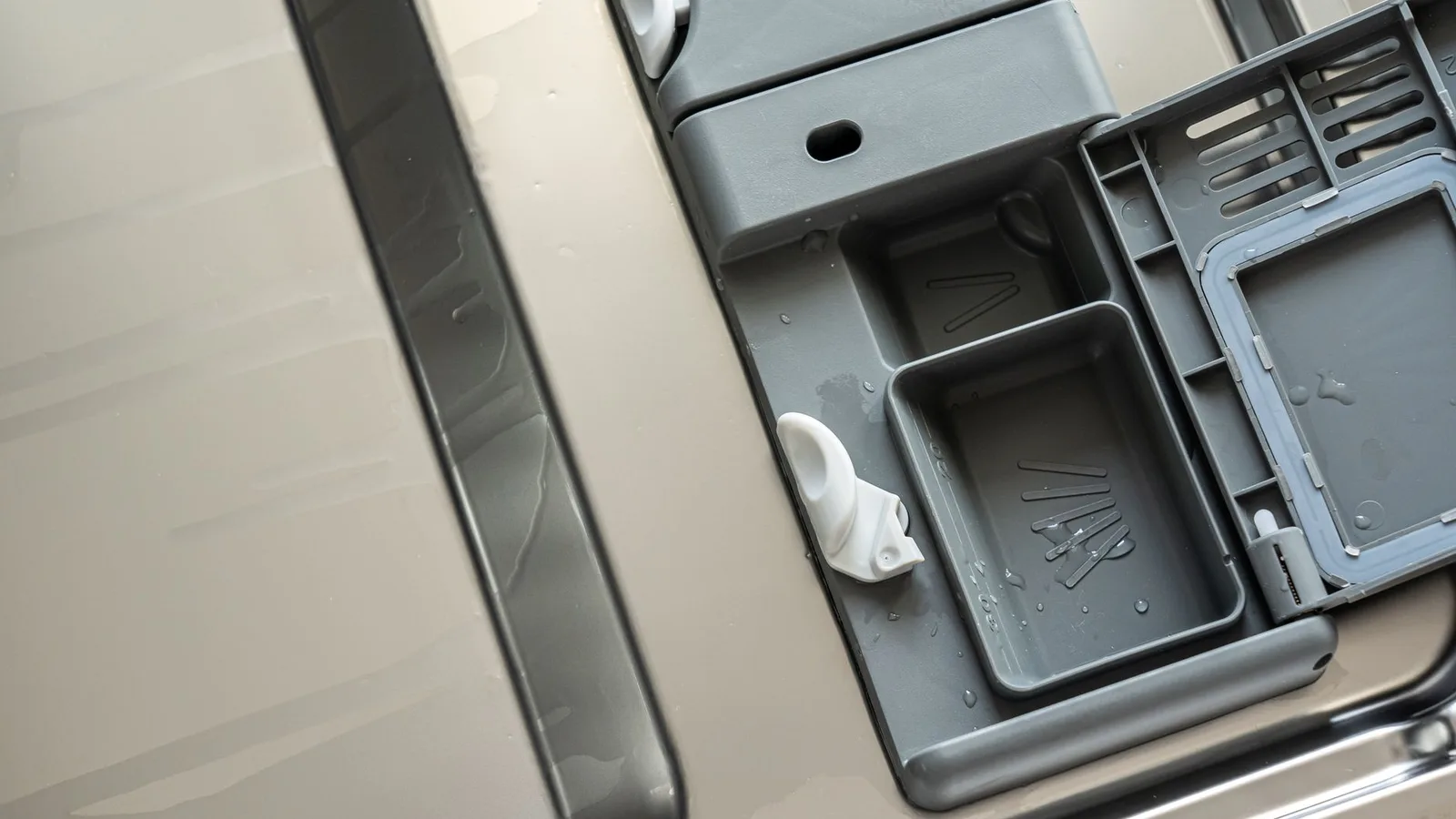
Open the door, and there's an inch of grey water sitting in the bottom. It's the single most common dishwasher call we get around Shellharbour, and a fair share of them clear without anyone coming out.
The trick is doing the checks in the right order, because each one rules out the next.
Turn it off first
At the wall, not just at the front panel. Everything below involves putting your hands where water and a pump are, and there's no version of this job where the machine needs to be live.
Bail the standing water out with a jug and a sponge before you start. It makes the rest far less unpleasant.
1. The filter
Almost every dishwasher has a cylindrical filter sitting in the base, usually with a coarse mesh plate around it. It unscrews by hand — a quarter turn, no tools.
Pull it out and look at it under the tap. Grease, seeds and label paper build a mat over the mesh, and once the mesh is blinded the pump can't move water through it. Wash it with detergent and a soft brush, not a scourer.
If it was visibly filthy, put it back, run a short cycle and see whether the problem is gone. Often that's the whole job.
2. The sump and the impeller
Under the filter is a shallow well — the sump — and at the bottom of it, usually behind a small cover, is the drain pump impeller.
This is where the odd stuff ends up. In the last year we've pulled out a fruit sticker, half a wine glass stem, a bread tag and a child's plastic ring. Any one of them will jam the impeller solid.
Reach in carefully. If the machine has broken glass in it, use a cloth, not fingers. If the impeller turns freely by hand, move on.
3. The drain hose
The hose runs from the machine to your sink trap or a standpipe. Two things go wrong with it.
It kinks, usually because the machine was pushed back too hard during a kitchen clean or a floor replacement. Pull the machine out far enough to see the hose run and straighten it.
It blocks at the trap, especially in kitchens that also run a waste disposal. The spigot on the trap where the hose connects is a narrow inlet, and disposal debris collects there. Undo the hose at that end into a bucket and check whether water flows.
While the machine is out, check the hose is looped high — up near the underside of the benchtop — before it drops to the trap. If it's not, the sink can drain backwards into your dishwasher, which looks exactly like a drainage fault and isn't one. We see this a lot in newer builds where the machine was installed in a hurry.
4. Now it's the pump
If the filter is clean, the impeller turns, and the hose is clear and correctly looped, the drain pump itself is failing. That's a genuine repair, and on most machines it's a straightforward one — a pump is a modest part and it's usually accessible from the front or the base.
The same symptom can also be a control board that has stopped calling for the drain, but that's much rarer, and it usually comes with other odd behaviour.
What the codes mean
If your machine shows a code rather than just sitting there wet:
- Bosch E18 / E24 — drainage, in that order: filter, impeller, hose, pump. More on Bosch faults.
- Samsung 5E or 5C — the same family of drainage fault.
- LG OE — drain error, again the same checklist.
- Bosch E15 — this one is different. It's the anti-flood float in the base tray, meaning water has got somewhere it shouldn't. Tipping the machine back about 45 degrees for a minute drains the tray and clears the code, but if it comes back you have a leak that needs finding.
When to just call
If you've done the four checks and it still won't drain, or the machine is leaking from underneath, or it's throwing a code you can't clear, book it in. The assessment fee is $125, fixed, and you get the repair price before any work starts.
We're through Shellharbour, Shell Cove and Oak Flats most weeks, so if you ring early a same-day visit is often realistic.