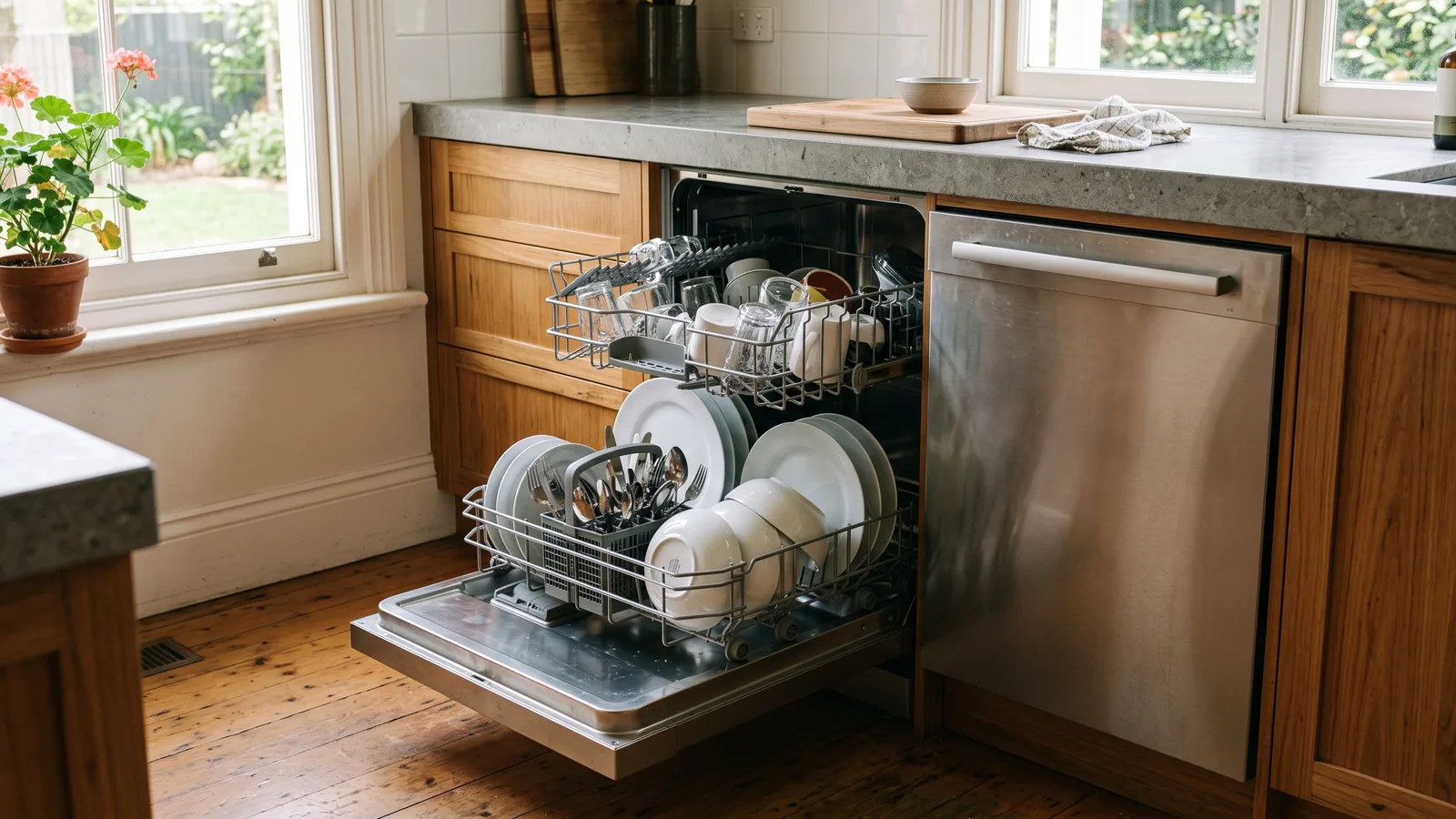
Two adults, four kids, one dishwasher going twice most days and three times on a weekend. The machine had just given up at a bit under six years and the family in Albion Park had made up their minds about the brand, which was reasonable enough from where they were standing.
I did the arithmetic on their kitchen bench while I was writing up the quote. Somewhere north of seven hundred cycles a year. A retired couple down the road doing three loads a week gets through about a hundred and sixty. Their machine hadn't died at six. It had died at something closer to twenty-five, and it had done the whole thing in the time it takes most machines to get out of their first decade.
That's the bit that gets missed. Everything about a dishwasher's life gets quoted in years, and years are the wrong unit for a busy house.
Cycles are what the machine counts
Nearly everything that goes wrong on a dishwasher is worn by use rather than by time. The drain pump starts and stops once a cycle. The detergent flap fires once a cycle. The door gets opened, loaded, shut, opened hot, unloaded. The circulation pump bearings do their hours. None of that cares what the calendar says.
Only a couple of failures are genuinely time-based, and they're the ones you'd expect: rubber going hard, and electronics that have spent years in a damp cupboard.
Which means a household like the one in Albion Park should be planning around a shorter machine life than the shop assumes, and buying accordingly. It isn't bad luck and it usually isn't a lemon. There's a bit more about how that suburb's appliances wear differently on the Albion Park page, because up off the water the story is load rather than salt.
The door seal, and why it takes the electronics with it
If I could get people to look at one part, this would be it.
The seal runs around the door opening, and it goes at the bottom two corners first, because that's where it gets folded hardest and where the water sits. It doesn't split dramatically. It flattens, loses its spring, and starts letting a thin curtain of steam out the front of the machine on the hot part of the cycle.
That steam goes up. Straight up the inside face of the door, which on most machines is where the control board and the touch panel live. A seal is a cheap part. A control board is not, and by the time the panel starts behaving oddly the seal has usually been leaking for months.
What you're looking for is water finding its way down the outside of the door once a cycle finishes, or a damp patch on the tile in front of the machine that you'd put down to drips off the plates. Neither of those is an emergency this week. Both are worth ringing about, because they're the difference between a small job and a big one.
Door springs, especially on an integrated machine
The door on a dishwasher is held by a spring and cable arrangement on each side, and it's tuned so the door eases down instead of dropping.
Cables fray and springs tire, and in a house doing two loads a day they do it years earlier. The tell is a door that falls the last third of the way, or one that won't stay put halfway open. Once it's dropping, the hinges start taking a shock load they weren't designed for and the seal gets mashed at the bottom, so it feeds straight back into the problem above.
This is worse on the integrated machines going into the newer estates, because that door is also carrying a cabinet panel and sometimes a stone-look handle rail, and all of that weight hangs off the same springs. Some models have heavier springs specified for exactly this and get fitted with the standard ones. If the kitchen went in three or four years ago and the door already drops, that's worth checking rather than living with. I've written separately about what's different about servicing built-in appliances around Flinders and Shell Cove.
Rack tips, which everyone blames on the water
The tines in the racks are steel wire with a plastic coating over the top. Loading and unloading a machine a thousand times chips that coating at the tips, water gets to the wire underneath, and the wire rusts.
Then you start finding little orange marks on the plates and on the inside of the door, and the usual conclusion is that something is wrong with the machine or with the water. It's neither. It's the racks, and near the coast it happens faster because there's chloride in everything, which is the same mechanism behind the brown freckling on stainless appliance doors.
Replacement tine caps come in packets and cost very little. Slide one over each bare tip and the marks stop. A whole rack is a bigger spend and is sometimes still worth it against replacing the machine.
Two habits that halve the wear
This is the part I'd actually change if I lived in a house like that.
Run it full. Two half loads do twice the damage of one full one and use close to twice the water, and the machine has no way of knowing you only put six plates in. A big household usually can fill it, and the reason they don't is that somebody wants a particular pan back.
And stop using the rinse-only cycle as a holding pattern. Plenty of people run a rinse when the machine is half full to keep the smell down, then run a full wash later. That rinse is a real cycle. The pumps run, the valve opens, the door gets opened twice more. If the smell is the problem, leave the door sitting open a crack instead and let it air.
The other one, and I'll get argued with about this: the quick cycle is not the gentle cycle. People pick it thinking less time means less wear. Most machines get a quick cycle done by using more heat and less soaking, and if the load then comes out needing a second run you've spent two cycles instead of one. The long eco programme is slower on the clock and easier on the machine, and it's the one I'd have as the default in a house doing seven hundred a year.
I'm deliberately not writing the filter-and-spray-arm maintenance list here, because it's well covered everywhere and it isn't really the wear story. Clean the filter, obviously. It just isn't what kills these.
When it does stop, check the cheap things first
A machine that won't drain is the most common call and about half of them sort themselves out without me, in a fixed order: filter, then sump, then hose. There's a full walk-through in dishwasher not draining and it's worth twenty minutes before you book anything.
What I'd add for the high-cycle houses is that the failures come in a different order than they do elsewhere. In a busy kitchen the drain pump and the door hardware turn up long before the heating element or the board does, and both of those are among the cheaper repairs on the machine. It's usually worth fixing a five-year-old workhorse once.
Twice is a different story, and I'd rather say so up front than quote you for a second repair on a machine that's telling you something.
Buying the next one for a house like yours
Two numbers matter far more when you're running seven hundred cycles than when you're running a hundred, and they're both printed on the ticket.
Energy per cycle is the first, and the registered figures for every machine sold here are on the government's dishwasher energy information. Water is the second, under the separate WELS scheme, where the label gives litres per wash along with the cycle it was measured on. That last part matters, because the tested cycle is usually the long eco one, not the one your household will actually press.
Multiply either number by your real cycle count rather than the average household's and the gap between two machines stops being trivial.
The third thing isn't on any label: can it be worked on. A drain pump you can reach from the front without pulling the machine out of the cabinetry is worth real money over a decade of use, and in an integrated kitchen it's worth more again. If you're specifying appliances for a new build, that's a question worth asking the kitchen company while the choice is still open.
Getting it looked at
We do domestic appliances only, across Shellharbour City and the lake suburbs. Assessing the machine costs $125, fixed, whatever it turns out to be, and you get a firm price for the repair before a spanner comes out of the van. If it isn't worth the money I'll say so on the day.
Book a visit or ring 02 4229 3777. Dig out the model number first if you can, and say roughly how often the machine runs, because in a house doing two loads a day the likely fault list is genuinely different.