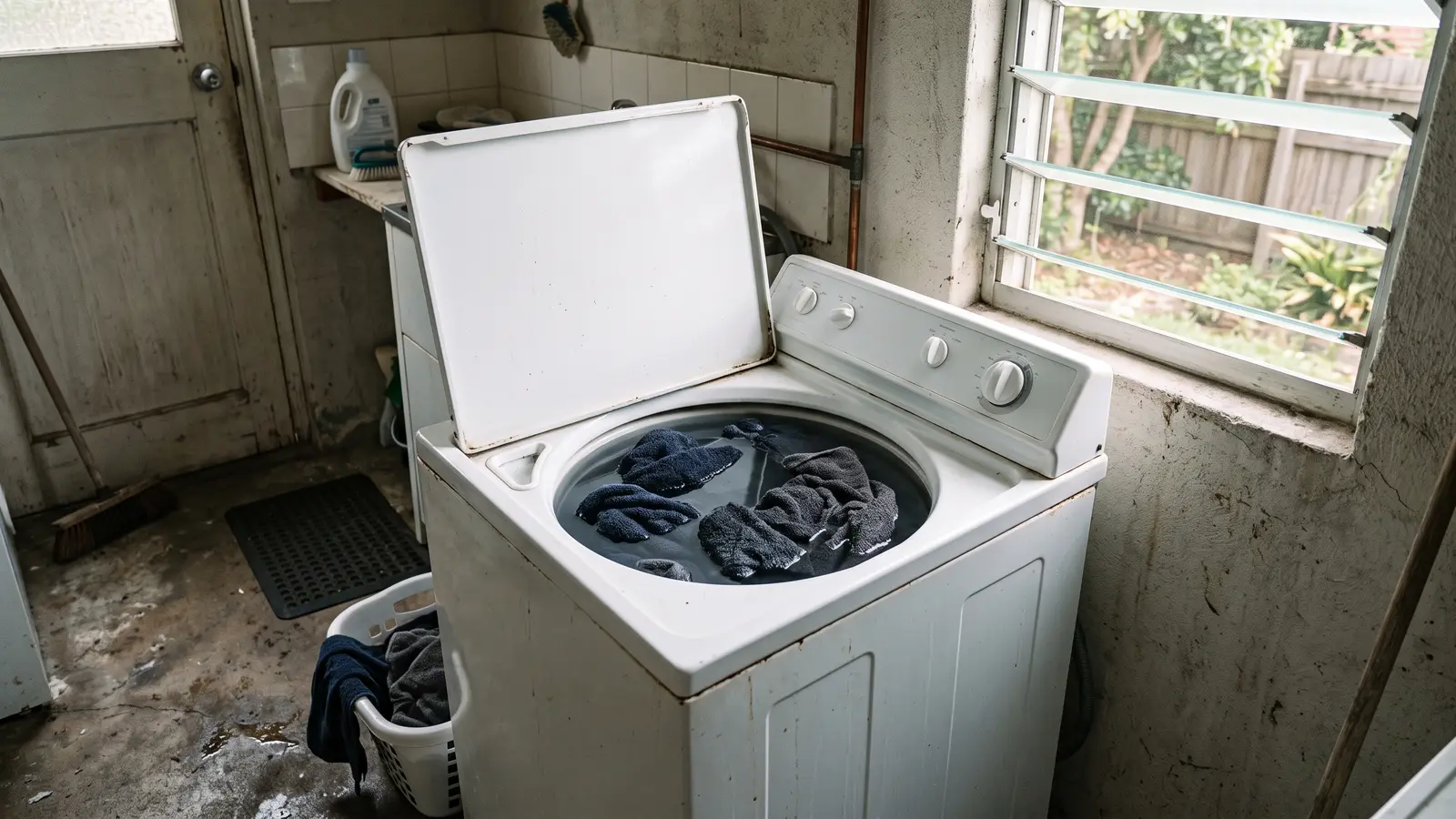
The machine was full to the top mark, the lid was down, and the whole laundry was dead quiet. The owner, out in Warilla, had already stood there through two attempts, and the second time she'd given the side of the machine a thump, which she told me about a bit sheepishly. Her son had looked at it and said motor.
It was not the motor. It was a lid switch worth less than a takeaway coffee, and I had it inside two minutes, because that's the first thing I check on a top loader that fills and then does nothing.
I've been doing this for ten years now and top loaders are still roughly half the washing machine work on the lake side of Shellharbour. The older weatherboard and brick places through Barrack Heights, Warilla, Windang and Mount Warrigal mostly have a laundry that was tacked onto the back as a lean-to, a concrete floor and a top loader, because that's what fitted and that's what got bought. They're simple machines. Which is the point of this post: the simple faults come first, and most of them are cheap.
What "fills and stops" actually tells you
A top loader does its wash in stages. Fill, agitate, drain, spin, and the control board waits for a signal before it moves from one to the next. If it filled, the inlet valve and the water side are fine. If it stopped dead after filling, the board is either waiting for a signal it never got, or it sent power to the motor and nothing happened.
Those are two very different problems, and you can separate the two from the laundry without any tools. Which is why I check things in a fixed order, and why I'd rather people did the first two steps before they book me.
First: the lid switch
Nearly every top loader made in the last thirty years refuses to agitate or spin unless it's sure the lid is down. On older machines that's a little plunger switch under the lid at the back, on newer ones it's a magnet in the lid and a sensor in the top panel, and on a lot of current machines it's a proper lock.
They wear out. Springs tire, plungers stick, the plastic tab on the lid that presses the switch snaps off. And a machine with a lid it can't confirm will fill, because filling is allowed with the lid up, and then sit there full of water forever.
Safe to try yourself: with the machine full and stuck, lift the lid and shut it firmly, and listen. On plunger switches you'll hear a small click. No click, or a click only when you press down hard on the lid, and you've probably found it. On the magnet type there's nothing to hear, but check whether the lid actually sits flat. A lid warped from years of a heavy basket being parked on it can sit a few millimetres proud, and that's enough. I've written more about how this shows up on one particular brand on the Haier page, because it is close to their signature fault.
What you shouldn't do: tape the switch down, or stick a spare magnet on the sensor so the machine thinks the lid is shut. People do this, and the machine will then happily spin at seven hundred revs with the lid open. That interlock is the only thing between a curious four-year-old and a drum doing that speed. Get the part changed. It's among the cheapest ones I fit.
Second: turn the drum by hand
Before anything, pull the plug out. Not the power button, the plug. Then reach in and try to turn the agitator, and try to turn the drum itself.
If both move freely, the mechanical side is probably fine and you're looking at either the lid switch above or something electronic. If the drum won't budge at all, there's a good chance something is jammed under it. A bra wire, a sock, a kid's toy, the plastic rim off a soap dispenser ball. It works its way down between the inner drum and the tub around it and wedges. That's a technician job on most machines, because getting the drum out is a fair bit of dismantling, but at least you know before you ring that it's a jam rather than a failure.
Also worth a look while you're in there: what's in the load. A single wet bath mat or a doona in a machine on its own will sometimes make the control refuse to start the agitate stage on a modern machine, because it reads as an off-balance load before it's even begun. Take it out, put in a couple of towels, and try again. Costs nothing.
Third: the agitator that moves at the bottom but not at the top
This one's specific to the two-piece agitators most top loaders have had since the nineties. The bottom fins turn, the top spiral is meant to ratchet round in one direction, and there's a little set of plastic teeth inside, called dogs, that make that ratchet work.
The dogs wear smooth. When they do, the bottom half of the agitator still goes back and forth but the top half sits there or spins uselessly, and the clothes stay floating on top instead of being pulled down. People describe this as "it washes but nothing moves" or they notice the clothes come out with dry patches. If you put your hand on the top of the agitator during a wash and it turns freely both ways with no ratchet feel, that's it.
Cheap part. On a lot of machines it's a ten minute job with a socket set and some patience, and on some it isn't, because the top cap has been glued in by twenty years of detergent.
Fourth: it hums and does nothing
Now we're onto the motor side, and this is where the phone diagnosis usually stops being reliable.
Humming without moving is the motor getting power and not being able to turn the load. On a belt-drive machine that's often the belt itself, glazed or snapped, and you'll sometimes smell hot rubber. On the direct-drive style with a coupling between the motor and the gearbox, the coupling is a small plastic and rubber part designed to be the thing that breaks, and it does. Both of those are moderate repairs. Then there's the clutch, which lets the drum slip during agitate and grip during spin, and a worn clutch usually shows up first as a weak spin rather than a no-agitate, but not always.
If there's a burning smell, or the hum turns into a buzz that goes on for more than a few seconds, kill it at the wall and leave it that way. A motor that's stalled and drawing full current is heating itself, and the thermal protection in some older machines is not something I'd want to rely on.
Fifth: silence
Full of water, lid switch fine, drum moves freely, and when it should agitate there is no hum at all. That's electrical. A motor capacitor on an older machine, or the control board, or the position sensing on the direct-drive machines that have no gearbox at all. Fisher & Paykel's top loaders are the well-known example, and they produce a fault that passes for a dead motor when the motor is fine. There's a longer note about that on our Fisher & Paykel brand page because that fault fools people more than any other, and guessing then buying a motor for it goes badly.
Here's where I'd stop trying things and ring. Everything above it, you can check yourself in a quarter of an hour and half of them you can fix.
Emptying it before anyone arrives
If the machine is full and you need it empty before anyone comes, don't bail it with a saucepan. Pull the drain hose out of the standpipe or off the tub, drop the end in a bucket on the floor, and let gravity do it. It'll take a few buckets. Then you can at least get the washing out and into the sink.
Don't tip the machine to help it along. There's a lot of water in a full top loader and they're top-heavy once you get past about ten degrees.
Whether it's worth fixing
On a top loader, nearly always yes for the first four things on this list. Lid switches, dogs, belts and couplings are cheap parts on a machine with not much else to go wrong, and an older top loader that gets one of those replaced tends to go on for years.
The exceptions are a gearbox, which on some machines costs as much as the machine did, and a control board on anything more than about a decade old, where the part is often either unavailable or silly money. I'll tell you which one you've got before you decide, because the assessment is quoted first and the repair is priced before I start on it.
If you do end up replacing it, the federal energy rating page on clothes washers says it plainly: top loaders are quicker and often more reliable, and they're harder on your clothes and use more water and power. Around the lake, where a lot of people are washing beach towels and work gear rather than delicates, plenty of households look at that and buy another top loader anyway. That's a reasonable choice, and I'd add one thing to it: if the old one had a habit of grit turning up in the dark washing, read about sand in the washing machine before you pick the next one, because the top loader hides that problem rather than solving it.
If it's still sitting there
Shellharbour City and the lake suburbs, domestic appliances only. Coming out to look at it is $125, which is payable regardless of what I find, and the repair itself gets a fixed price before I touch anything. If you've done the lid check and the hand-turn test, say what happened when you ring 02 4229 3777 or book online. It genuinely changes which parts go in the van.