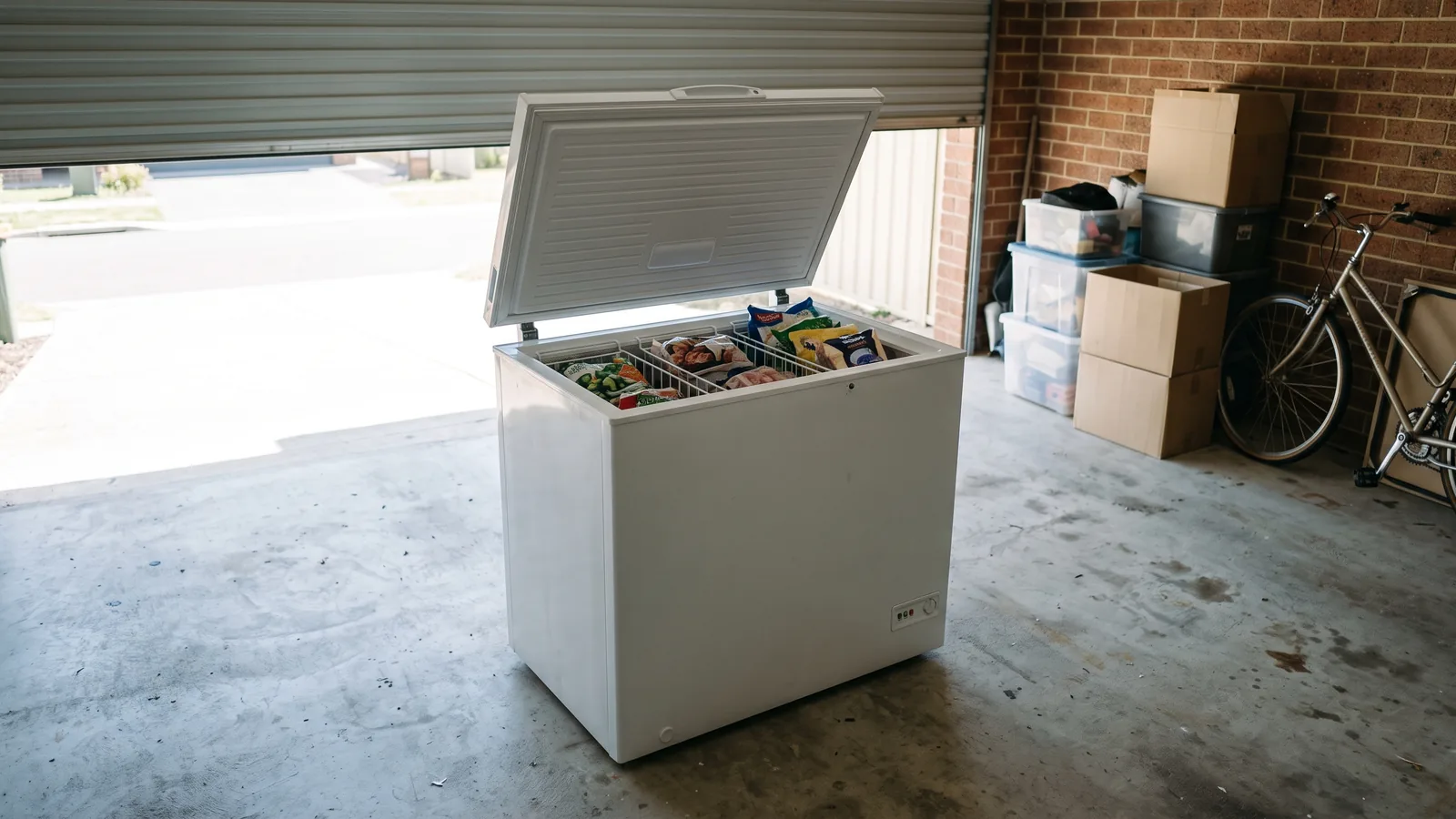
Somebody in Flinders rang me in March, about five weeks after their chest freezer arrived. It ran almost constantly, the lid felt warm to the hand, and the first quarterly bill had come in higher than anyone had budgeted for. The question was whether to send it back.
There was nothing wrong with it. They'd done a tidy job of building it into the garage, with a shelf across the top and maybe two fingers of gap down each side, and the machine had been slowly stewing in its own waste heat since the day it was delivered.
That's the thing about chest freezers. They're the simplest cold appliance you can buy and the one people get wrong most often, because almost every decision that matters gets made before it's ever plugged in. Once it's in the corner, it's in the corner.
I end up in this conversation a fair bit, partly because the garage fridge post tells people to buy one of these and then stops dead. So here's the rest of it.
Size it off what you actually buy
The sum I use is about two litres of freezer for every kilo you want to keep in it. A 200 litre box takes roughly a hundred kilos of packed food, and that's with the air gaps and awkward shapes that real packets have, not a theoretical brick of solid meat.
Work backwards from your biggest single buy. If you split a lamb with your sister twice a year, or you go in on a bulk order and come home with eight cartons, that's the number the freezer has to swallow in one afternoon. Everything else fits around it.
Two things people don't account for. Butcher's cartons waste an enormous amount of room, so plan on unpacking them, and a freezer that's stuffed to the lid is a freezer where the thing you want is always at the bottom.
Going bigger than you need isn't free either. You're paying to keep the empty air cold for however long you own it, and around here that's fifteen years easily.
Chest or upright, and why I keep saying chest
Cold air is heavy. That single fact decides most of this.
Open an upright and the cold sits down and pours out around your feet, and the machine has to make it all again. Open the lid on a chest and the cold stays in the box, because there's nowhere for it to go but up past your hands. Stand there with the lid open for two minutes looking for the sausages and you've lost far less than you think.
Uprights win on one thing and it's a real one: you can see what you own. Nobody has ever found anything in the bottom layer of a chest freezer without emptying the top two. Baskets help. Not much, but they help.
The other split is defrosting. Most chest freezers are manual, which means once every year or two you empty it and let the ice come off the walls. Most uprights sold now are frost-free, which is genuinely more convenient, and which works by periodically warming the evaporator so the frost melts away instead of stacking up. That cycling is fine for a fortnight's shopping and it's harder on food that's going to sit there for eight months. If you're storing a bulk buy rather than a week of dinners, manual defrost keeps it in better condition.
The room is doing more work than the machine
Here's the part almost nobody is told in the shop.
A lot of chest freezers don't have a condenser coil on the back at all. The condenser is bonded into the cabinet walls themselves, which is why the sides go warm when it's working hard. It's called a skin condenser and it's a good design. There's no coil to vacuum out and nothing for salt and dust to pack into, which around Warilla and the beachside end of the patch counts for a lot.
The catch is that the entire outside of the machine is the heat exchanger. Box it in and you've insulated the one surface that was supposed to be shedding heat. That's what happened in Flinders. Every side of that cabinet needs moving air, and a shelf sitting 50mm above a warm lid is not moving air.
So: gap on all four sides, nothing stacked on top, and don't push it hard against a wall that gets afternoon sun on the other side.
Ambient temperature does the rest. A freezer in a west-facing garage in February is being asked to dump heat into a room that's already 40 degrees, and it will run and run and never look like it's coping. That's not a fault, and it's a much cheaper sentence to hear on the phone than to pay somebody to come and say in person.
One thing that doesn't apply to chest freezers, and this surprises people: the winter problem that ruins garage fridges isn't a thing here. That fault comes from a machine with two compartments and only one sensor. A chest freezer has one compartment, so the sensor is sitting in the only space it needs to care about. A cold garage in July doesn't confuse it.
The lid, and the bit above the lid
Measure the clearance above where it's going before you buy, not after.
A chest freezer lid swings up and back, and on plenty of them it needs close to the height of the machine again to get all the way back. Under a bench, under a window, under a shelf, under the stairs, all of these look fine with the tape measure flat on the floor and then don't open. I've been out to two that could only be opened about a third of the way and had been used like that for years.
While you're looking at the lid: the hinges and the seal are the two parts that suffer near the water. A machine parked in a carport, or in a laundry that's open to the yard, with salt air moving over it will lose its hinge springs before it loses anything electrical, and a lid that no longer pulls itself shut is a lid that gets left ajar. It's the same chloride that leaves brown freckling on a stainless fridge door.
Give it its own powerpoint
This sounds fussy. It isn't.
A freezer is the one appliance in the house where losing power quietly for a day costs you real money, and the cheapest insurance is not sharing its outlet with anything that trips. That means no double adaptor with the beer fridge, no piggybacking off the powerpoint that also runs the workshop gear, and no extension lead running under the roller door.
The failure I see is never the freezer. It's a drill or a pressure washer on the same circuit dropping the safety switch on a Friday, nobody noticing until Sunday, and a full freezer that has to be thrown out. I've written about what a tripping safety switch is actually telling you, and it's worth understanding, but the short version for freezers is: keep it off circuits that have anything interesting on them.
Put a note on the switchboard too, if it's a garage circuit. Half the time somebody has turned it off deliberately and forgotten.
What happens when the power does go
The NSW Food Authority's guidance on power cuts and food safety puts it plainly: a freezer will usually hold for about 24 hours provided nobody opens it, and anything that has thawed shouldn't go back in frozen.
Two things follow from that. The first is don't open it to check. Opening it to see how it's going is the one action guaranteed to make it worse.
The second is that a full freezer rides out a blackout far better than an empty one, because what's holding the temperature during those hours is the frozen food itself, not the machine. If yours normally sits half empty, a few two-litre bottles of water frozen solid in the bottom cost nothing and buy you hours.
And if the house sits empty between visits, which a lot of places around Shellharbour and Shell Cove do, freeze a cup of water, sit a coin on top of the ice and leave it in there. Come back and find the coin at the bottom of the cup and you know the whole thing thawed and refroze while you were away, whatever the display says now. Same logic as the rest of locking up a house that sits empty.
Reading the ticket in the shop
Stars are the wrong number to compare, and this catches everyone.
The star rating is calculated within a size band, so a five-star small freezer and a four-star large one are not being marked on the same scale. What you want is the kilowatt hours per year figure printed underneath, because that one is absolute and you can put two very different machines side by side with it. The government's running cost information for fridges and freezers has the registered numbers for everything sold here.
Then adjust it in your head for the room. Those figures come off a test at a set ambient temperature, and a machine living in an uninsulated garage on the flat at Oak Flats is not being asked the same question the test asked. Somewhere shaded, under the house, or in a laundry the weather never gets into will beat the label. A hot garage won't.
When to get someone out
Most of what I've written here isn't repair work, and I'd rather people got the siting right than rang me in eighteen months.
That said, if a freezer that used to be fine has started running non-stop, or the food is going soft, or there's ice building somewhere there wasn't ice before, that's worth a look and it's usually something small. Bring the model number to the phone call.
Coming out to assess it is a fixed $125 fee, and you get a firm price for the repair before anything gets touched. Domestic appliances only. Book a visit or ring 02 4229 3777, and if you're still at the shopping stage, ring anyway and tell me the room. That part is free and it's where the money actually is.