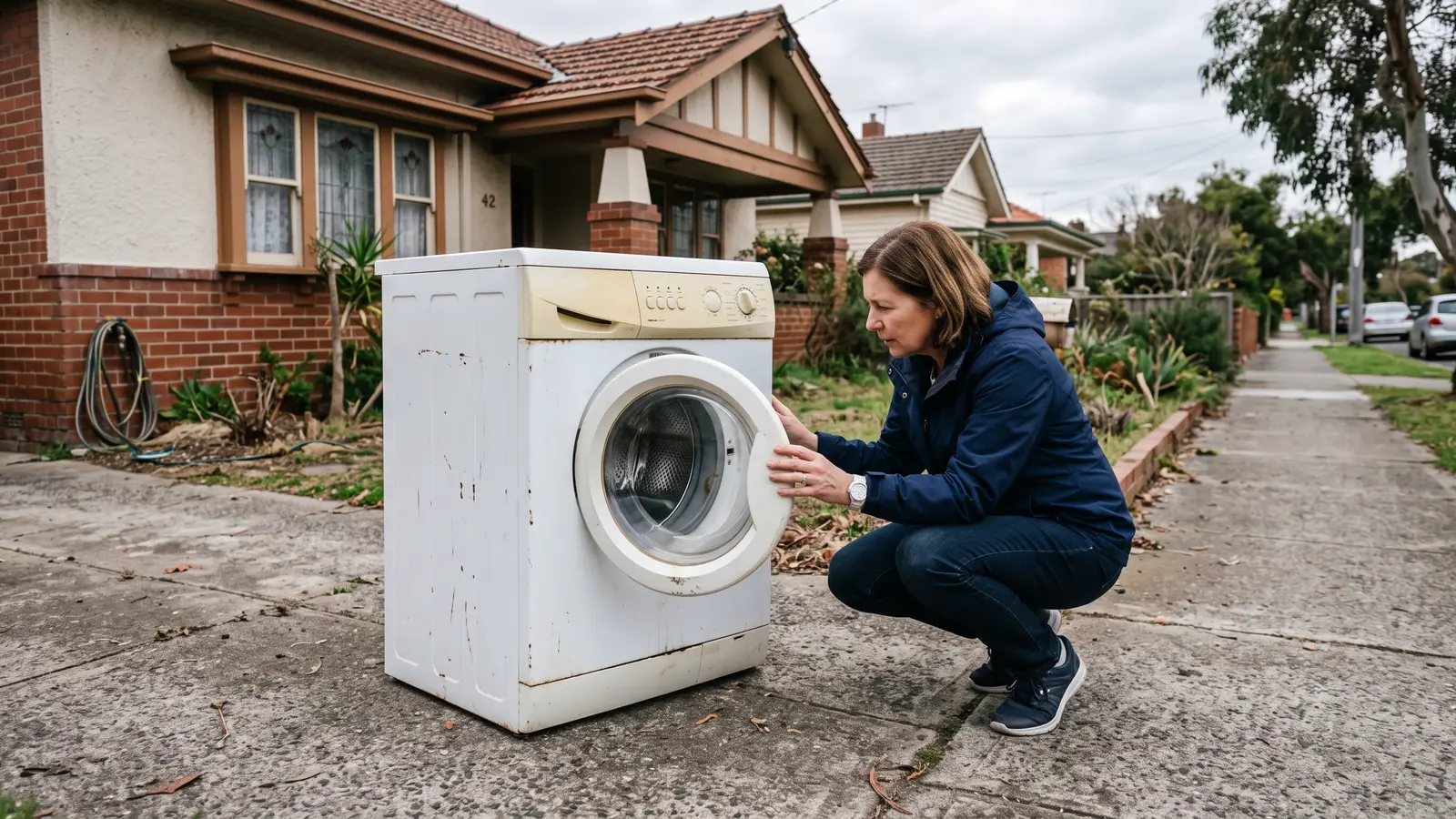
Bloke rang me last winter about a front loader he'd bought off Marketplace for two hundred dollars. Picked it up from a driveway in Warilla, got it home, ran a load, and it sounded like a cement mixer full of gravel on the spin.
Drum bearings. On that machine the bearings are pressed into the outer tub and the outer tub is sealed, so it isn't a bearing job, it's an outer tub job — and by the time you've paid for the part and the labour to get the drum out and back in, you're a long way past what the machine is worth. I quoted him and he didn't proceed, which was the right call. He'd paid two hundred for the machine, a hundred and twenty-five for me to tell him that, and then had to get rid of it, which around here is not free either.
He was annoyed, reasonably, and the thing he kept coming back to was that the seller had run it for him. Which she had. She'd run it on a rinse cycle in the laundry, where it filled, tumbled gently and drained, and never once went near a spin. That is where the noise lives.
I'm not down on buying second-hand. I've got a second-hand freezer in my own garage. But there's a gap between what a seller shows you and what you need to see, and almost all of it closes in about ten minutes if you know where to look.
You have no consumer rights here, and that changes everything
Start with the thing nobody mentions in the driveway.
When you buy an appliance from a retailer, Australian Consumer Law comes with it — guarantees about the thing being of acceptable quality and fit for purpose, and they apply on top of any warranty, including on a discounted or a seconds unit.
Buy the same machine from a person, and none of that exists. NSW Fair Trading say it plainly: Australian Consumer Law does not apply when you buy from a private seller, because they aren't acting in trade or commerce. It's a consumer-to-consumer transaction and contract law applies instead. You're entitled to expect that they actually own the thing and it isn't security for a debt. You are not entitled to expect that it works next week.
So the inspection is the whole protection. There is no second bite.
Worth saying the flip side: a second-hand dealer, an op shop or a refurbisher is a business, and the guarantees do come back. If the price difference between a driveway and a dealer is fifty dollars, the dealer is often the better bet for that reason alone.
Make it do the hard part
What actually protects you is refusing to leave until you have seen the part of the cycle where machines fail, which is never the part a seller volunteers.
On a washing machine that means a spin. Not a wash, not a rinse — a spin, at full speed, with something in it. A towel is ideal because it's heavy when wet and it makes the machine work to balance. Rumbling, grinding or a rising roar as it speeds up is bearings, and on most front loaders that's the end of the conversation. Some knocking as it finds its balance at the start is normal. A constant noise that gets louder with the speed is not.
While it's spinning, rest your palm on the top of the cabinet. A bit of vibration is fine. A machine trying to walk across the laundry with one towel in it has a problem.
On a dryer, run it hot for fifteen minutes and then feel the air coming out. Warm is right. Cool means it's tumbling and not heating, and that's a thermal cut-out or an element. Listen for a rhythmic squeak or a rumble, which is usually the drum rollers or the belt.
On a dishwasher, you want a full cycle, and most sellers won't wait for one. A short cycle at least tells you it fills, heats and drains. Put your hand on the door near the end — if the water never got hot, the element's gone.
On a fridge, the hard part is time, which you don't have. So check what temperature it is actually holding rather than whether it's running, and open it up and study the rear panel inside for a sheet of ice, which means the defrost side has given up.
Look underneath and behind
This is the coastal bit, and around here it matters more than anywhere.
Machines that have lived in a beachside laundry, a carport at Warilla or an open garage at Barrack Heights corrode from the bottom and the back, which are the two places nobody looks. The front panel can be immaculate and the base frame can be lace.
Tip a washing machine back gently and look at the base. Surface rust is cosmetic and I wouldn't worry. Flaking, bubbling or anything you can push a fingernail through is structural, and a corroded base frame is not economically repairable — the machine is a write-off wearing a nice front.
On a fridge, find the condenser coils — a black grid on the back of older ones, tucked underneath on most newer ones. Furred with dust is normal and cleanable. Corroded, with the fins crumbling off the tubes, is a fridge that has lived in salt air and is on borrowed time. That's the same story as a fridge that runs constantly and never gets cold.
Check the door seals on everything. Run a finger round them. Hard, cracked, gappy or flattened seals are a cheap part on most machines but they aren't free, and a perished seal tells you the machine has had a hard or a hot life.
And the smell test on a front loader. Open the door and put your head near it. That sour smell means years of cold washes and too much detergent, and it usually comes with a sump and a bellows full of sludge.
Age, and the parts question behind it
Ask how old it is, then check it yourself on the rating plate — the sticker on the door frame, the back or under the lid. Most carry a manufacture date or a serial number that encodes one.
I'm relaxed about age on its own. I regularly repair twenty-five-year-old ovens that will outlive their owners, because they're mechanically simple and the parts are still made. I'm much less relaxed about an eight-year-old machine with a big touchscreen, because the part that fails on those is the control board, and a control board for a discontinued model is where repairs stop being possible. Not expensive. Impossible. There's nothing to order.
The brand matters here more than the year. Something that's been sold in volume in Australia for decades tends to have parts around; I've written about why that works out well on Westinghouse. A brand that was in Harvey Norman for two years and vanished is a different bet, however good the machine is.
So the question to ask yourself isn't "how old is it", it's "if the expensive part fails, can I buy one". If you can't answer that, you're buying a machine you can't have fixed.
Do the sums properly
Work out what you'd pay to have it wrong. If a $250 washer needs a $400 repair, you don't spend $400 — you lose the $250 and buy something else. That's the real risk, and it's the arithmetic in repair or replace run backwards.
Which is why I'd rather see people spend a bit more on something newer and boring than get a bargain on something complicated. A five-year-old machine from a brand with parts, at $400, is a better buy than a two-year-old premium unit at the same price with a board nobody stocks.
Getting it home is its own hazard with a fridge, incidentally. Laying one flat in a ute and plugging it in the same evening is how a perfectly good second-hand fridge gets blamed for dying — the standing-up rule is here.
A few things that sound bad and aren't
Balance, since I've spent most of this post telling you what to walk away from.
A washing machine that walks on a bare tile floor might just have its transit bolts still in, or a foot wound out. Cheap and fixable. A dishwasher with a rusty bottom rack is a $40 rack and rust marks on your dishes, not a dead machine. An oven with a drifting thermostat that runs twenty degrees cool is a cheap part, and plenty of people live with it for years. A fridge with a broken shelf or a missing crisper lid is a part order and a bit of hunting, not a fault.
None of those are reasons to walk. They're reasons to get the price down.
If it turns out you bought a problem
If you've already handed over the money and the thing is misbehaving, I can come and tell you what's wrong with it. We cover Shellharbour City and the lake suburbs, domestic appliances only, and the visit is $125 whatever I find — including when the answer is that it isn't worth fixing, which on a cheap second-hand machine it sometimes isn't. That fee is payable either way. Any repair is priced before I start and the work is warranted.
If I were you I'd rather spend the ten minutes in the driveway. But if it's already in your laundry and making a noise, book it or ring 02 4229 3777 and describe what it does on the spin.