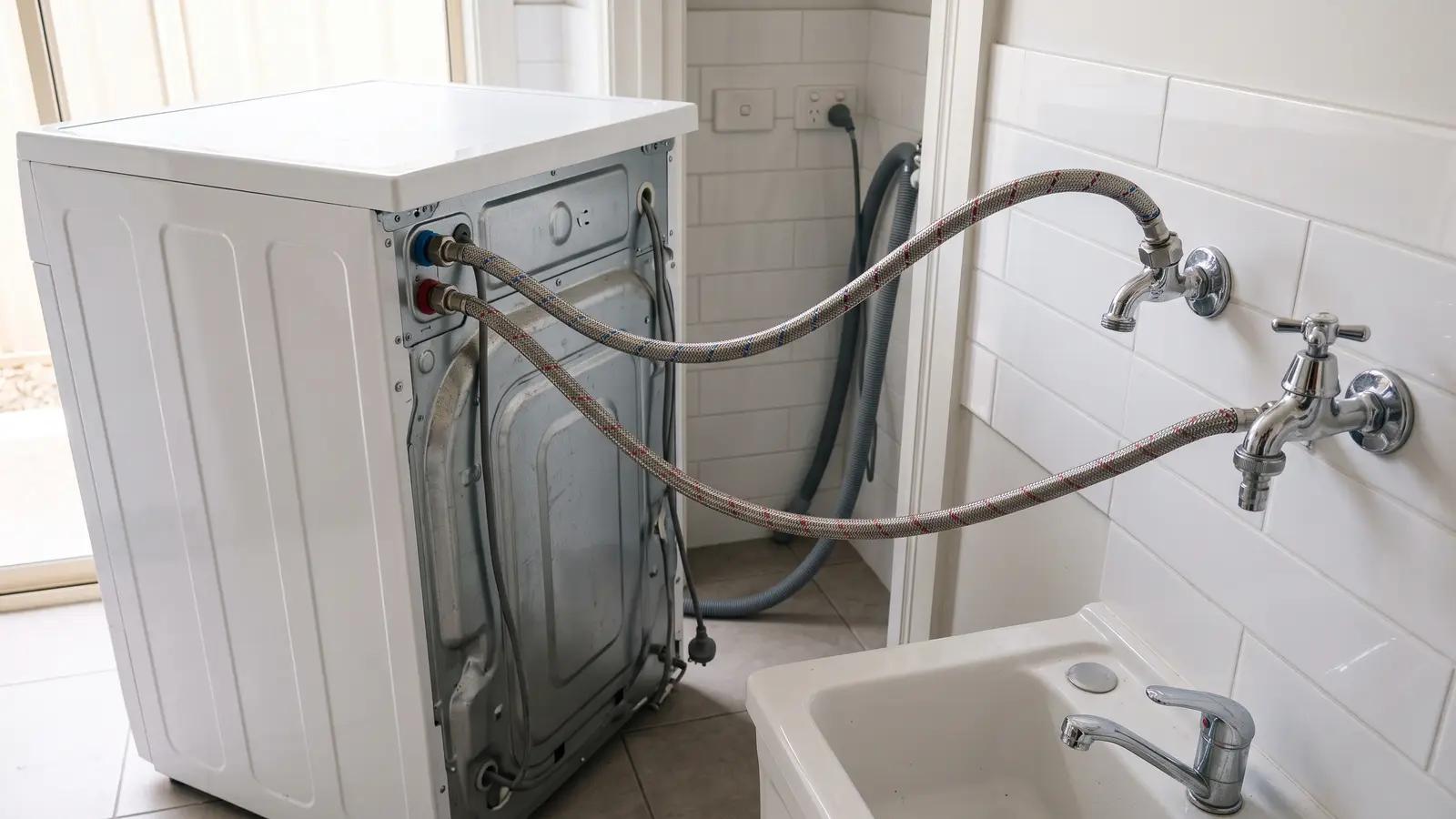
New house in Shell Cove, three weeks in, and the front loader the builder's package had supplied would start a cycle, run water in for a bit, stop, run a bit more, and then give up with an error code and a beep. The owner had already been on the phone to the retailer, who said it wasn't a warranty thing because the machine was clearly fine, and to the builder, who said the plumbing was signed off.
Both of them were right, which is the frustrating bit.
The cold tap behind the machine was open about a third of a turn. Whoever connected it had cracked it open to test for leaks and never gone back. The machine wasn't broken and the plumbing wasn't either. It was just being starved, and modern machines don't tolerate being starved. They time the fill, and when the water doesn't arrive at the rate they expect they assume something's wrong and stop.
I get some version of this call every couple of weeks, and of all the appliance faults I see, it is the single fault where I'd honestly rather you spent fifteen minutes on it before you paid me, because the first three things on the list are free.
Why a slow fill turns into a fault
Older machines filled until a level sensor said stop, however long that took. If the tap was barely open, the wash took an extra half hour and nobody noticed.
Anything built in the past decade or so also runs a clock. If the level hasn't come up within a set time, the control stops and reports a fill fault, because a fill that never completes usually means a hose has come off and the laundry is filling instead of the drum. Sensible design. But it means a machine that would once have quietly coped with a half-open tap now refuses to run at all, and to the owner it looks like a broken machine.
So the first job is always the water getting to the machine, and only then the machine itself.
Both taps, all the way
Go behind the machine. Both taps should be open fully. Not a bit, not "on", but wound out until they stop, then back a quarter turn so they don't seize.
Two catches. Some machines only have a cold connection and a blanking cap on the hot, which is fine. But a machine with a hot inlet and a hot tap that's off will sometimes stall on any cycle that expects a warm fill, even if you've selected cold, because the valve opens and nothing arrives. Turn the hot on too.
The second catch is the tap itself. The little washing machine taps in a laundry alcove get a hard life, and one that's been turned off and on a few dozen times over a decade can have a washer that's swollen or come adrift and is half blocking the outlet with the tap fully open. If the tap is fully open and the flow from it into a bucket is a dribble, that's a plumber, not me. But it's the tap and not the machine, and you know before anyone gets a callout.
The hose behind the machine
Out in the new estates the laundry is often a cupboard-width alcove and the machine gets shoved back into it hard. The inlet hoses fold. Not a tidy kink, usually, but a slow crush against the wall that gets worse each time someone pushes the machine back after mopping.
Drag the machine forward thirty centimetres and look. If a hose has a flat spot or a sharp bend, straighten it and see if the fill changes. Hoses have a memory and a badly creased one won't fully recover, so a new hose is a cheap fix. While you're there, look at the age of them. A stiff, chalky or bulging inlet hose is a burst waiting to happen, and I'd change it on sight regardless of the fill problem. I've said this before in the post on houses that sit empty and it applies just as much to a house that's lived in.
The screens nobody knows are there
Of everything on this list, this is what I most want people to know about, because it's the most common genuine cause and it takes a quarter of an hour at most.
Where each inlet hose screws onto the machine's back there's a small mesh screen, either sitting in the end of the hose or pressed into the valve inlet. Its job is to catch grit before it reaches the solenoid valve. It works. It catches grit until it's full of grit, and then the fill slows to a trickle.
What fills them is sediment in the mains, and that arrives in bursts. A water main break up the road, a new connection in the street, or the fill after the water's been off for a day, and a slug of rust and sand comes down the pipe and lands in your screens. New estates are worse for it because the streets are still being connected. Shell Cove, Flinders, the newer parts of Albion Park, they all get it.
To clean them: taps off, lay an old towel on the floor, unscrew both hoses from the machine. Some water will spill, not much. Look into the valve inlet on the machine. If the screen is in there, it's a little dome of mesh and it'll come out if you grip the rim with long-nose pliers, gently, straight out. Run it under the laundry tap, scrub it with a toothbrush you've retired if it's caked, and push it back the same way it came. If the screen is in the hose end instead, same thing. Reconnect, hand tight and a nudge, taps on, check for drips.
Grit-coloured and packed solid is a clear answer. A clean screen means you move on.
Pressure, and living up a hill
Some of it is simply how much water pressure the house gets. Sydney Water, who supply this whole area, are quite open that properties in high areas receive lower water pressure, and that they actively manage pressure down in parts of the network to reduce main breaks. Up on the ridge behind Shell Cove, the higher streets in Flinders, the top of Blackbutt, the fill can be genuinely slow with everything working as intended.
A machine on a low-pressure supply isn't faulty. It's just at the edge of the fill timer, and it'll be worst at breakfast time when the whole street is in the shower. Running it at a different time of day is a legitimate fix. So is a machine with a longer fill tolerance, which is worth putting to the retailer if you're replacing one on a high block, though in my experience they won't know the answer.
If the pressure has dropped suddenly, though, or you've got no water at all, that isn't an appliance problem at all. Sydney Water's own advice on that page is to ring their 24-hour line on 13 20 90, and I'd do that before anything else.
Then, and only then, the machine
If the taps are open, the hoses are straight, the screens are clean and the flow into a bucket from the tap is strong, the fault has moved inside the machine, and that's my cue to stop and book it.
Inlet valves are solenoids, one coil per hose on most machines, and they fail in two ways. Dead coil, no click, no water on that side, which shows up as a machine that fills cold but never warm or the reverse. Or a diaphragm that's gone hard and only half opens, which gives you the slow fill with everything else perfect. Not an expensive part, and on most front loaders it's right at the top of the machine behind the lid.
Then there's the level sensing. Most machines run a thin air hose from the base of the tub up to a pressure switch, and if that hose has a split or a blockage of sludge the control gets the wrong story about how full the drum is. That can present as a slow fill, a fill that stops early, or a machine that fills, drains and fills again in a loop. It's a diagnosis rather than a guess, and it's the reason I'd rather look at the machine than sell a valve over the phone.
The fill that won't stop
The opposite fault, quickly, because people confuse the two on the phone. One that fills, keeps filling, or tops itself up after it's finished, is a valve that won't shut or a level sensor that can't tell it's full. Turn it off at the powerpoint and close both taps, because that one can flood a laundry, and don't run it again until it's been looked at.
Booking it
We cover Shellharbour City and the suburbs around the lake, domestic appliances only. The visit is $125 whatever we find, including if it turns out the tap was off, and any repair gets a fixed price before I start. Mention the error code when you book online or call 02 4229 3777, and whether you've cleaned the screens. If you have, I'm coming with valves in the van rather than a toothbrush.