Why is my Fisher & Paykel dishwasher not draining?
A Fisher & Paykel dishwasher that will not drain usually has a blocked filter, a bent drain hose or a blocked drain connection. What to check safely, what the codes mean and when to book.
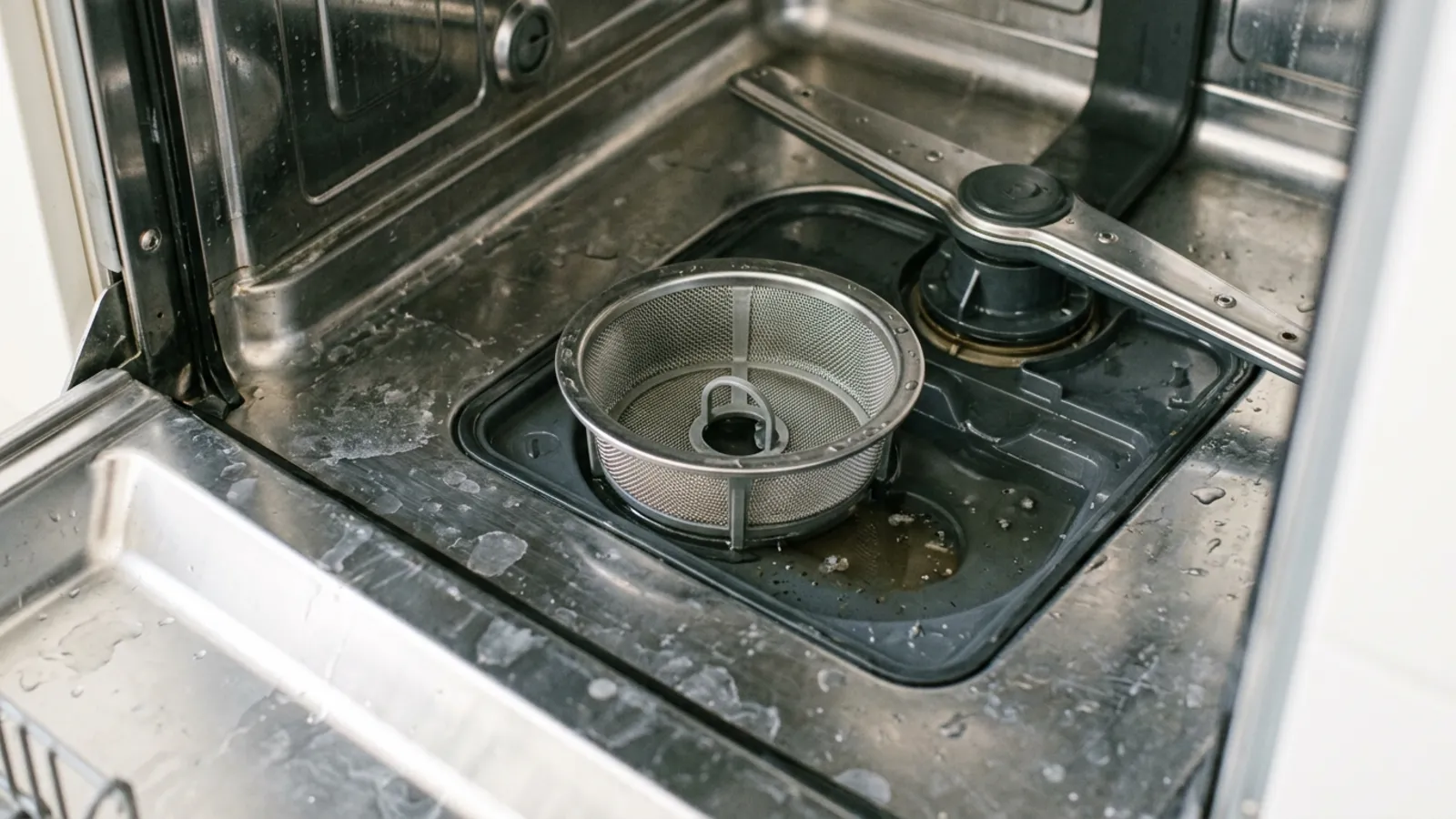
A Fisher & Paykel dishwasher that will not drain usually has a blocked filter, a bent or blocked drain hose, or a blocked waste connection. If those checks are clear, the cause is usually a pump or control fault that needs an authorised technician. Find the model number on the rating label first, as fault codes differ between DishDrawer generations and conventional models.
What are the usual reasons a Fisher & Paykel dishwasher will not drain?
Most draining faults in a Fisher & Paykel dishwasher stem from a blocked filter, a bent or kinked drain hose, or a blocked waste pipe connection under the sink.
In a DishDrawer, excess water left in the drawer normally traces back to a bent drain hose or a blocked filter. Water sitting underneath the filter is normal and needs no action; the fault is standing water remaining above the filter plate after a cycle finishes. On the conventional DW60 range, water left inside the dishwasher after a wash can come from blocked filters, a crimped or blocked drain hose, a blocked drain connection, or a jammed drain pump.
Plumbing layout also affects drainage. A hose that droops below the sink spigot, extends too far into a standpipe, or drains into standing water without an air gap can stop waste water clearing. DishDrawer installation should be carried out by a trained service technician or qualified person. For other dishwasher brands, our post on general dishwasher draining checks covers broader causes.
Is a DishDrawer different from a standard dishwasher when it will not drain?
Yes, a DishDrawer differs from a standard dishwasher because double models monitor and report faults separately for each drawer. A drainage fault can appear in one drawer or in both, and both drawers can show different fault codes at the same time.
If only one drawer stops draining and there is no leak, you can keep using the other drawer while you organise service. Conventional models such as the DW60 range have a single wash compartment and use their own fault code series. Confirming if your machine is a single DishDrawer, a double DishDrawer or a conventional model is the first detail needed before checking codes or booking Fisher & Paykel repairs.
What can I safely check when my Fisher & Paykel dishwasher is not draining?
You can safely inspect the visible drain hose under the sink and clean the drain filter and filter plate, as long as you isolate power first. Before doing any cleaning or maintenance, disconnect the dishwasher from the power supply and allow it to cool. Turn off the water supply tap as well if the machine is leaking.
With power off, check the external hose, waste connection and filters:
- Look under the sink to make sure the drain hose is not bent or kinked and stays securely connected to the dishwasher and the drain. Straighten a bent hose gently without forcing it.
- Check where the hose meets the sink waste pipe for a blockage restricting the outlet.
- Lift out the drain filter and filter plate and wash them in hot, soapy water. Both the drain filter and filter plate should be removed and cleaned once a month, or whenever food particles show.
Stop after those checks. Do not lift the dishwasher out, remove panels, touch wiring, or open any pump housing or cover. A jammed or failed pump needs a qualified technician handling dishwasher repairs.
Why does my Fisher & Paykel dishwasher beep or flash and not drain?
Continuous beeping with flashing indicator lights means the dishwasher has detected a fault, while intermittent beeping means the cycle is paused. When a DishDrawer is beeping intermittently, close the drawer and press START to resume the wash.
On integrated DishDrawer control panels, the flashing pattern shows the fault group: wash modifier indicators flashing alone signal an A fault, while wash modifier and lock indicators flashing together signal an F fault. Double models also flash the drawer indicator to identify which drawer logged the fault.
Current DishDrawer models show fault code A3 when the drawer cannot drain because the drainage hose is blocked or kinked, or the drainage pipe connection is blocked. Conventional DW60 models use fault code A20 for a drain fault, pointing to a crimped or bent hose, a blocked drain connection, incorrect hose routing, a dirty turbidity sensor, or a blocked drain pump. Always confirm the code against your model's user guide, because older DishDrawer models with model numbers ending in 5, 6 or 7 use A3 alongside U series codes with different meanings.
Take a photo of the display before resetting and check what to write down when a code appears. To clear A3 on a current DishDrawer after checking the hose and pipe connection, press once to stop the beeping, again to clear the fault, and once more to resume the wash program. For an F fault on a DishDrawer, press to stop the beeping, press again to turn off, wait a few seconds, and turn back on. If the code returns, disconnect power, turn off the water supply, and book service.
When should I book an authorised Fisher & Paykel repairer?
Book an authorised Fisher & Paykel repairer if standing water or a fault code comes back after cleaning the filter and checking the hose, if the dishwasher is leaking, or if any code will not clear.
Say the top drawer of a double DishDrawer stops and displays A3. You switch off power, clean that drawer's drain filter and filter plate (the monthly cleaning interval), check the hose under the sink for kinks, and confirm the waste connection is clear. You also check the plumbing against one DishDrawer family's install figures: the drain hose support sits as close to the benchtop as possible and at least 750 mm from the floor, the hose end is at least 500 mm from the floor, no more than 120 mm of hose extends into a standpipe, and a spigot sits higher than standing water with an air gap and no excess hose drooping below it. Because those measurements come from one DishDrawer family's installation guide, check the installation guide for your own model. Power goes back on, you clear A3 and run a cycle, and A3 returns. At that point, book a technician.
Shellharbour Service Company is an authorised repairer for Fisher & Paykel across Shellharbour, Shell Cove, Oak Flats, Albion Park and Lake Illawarra suburbs, with technicians travelling to your home and no shopfront. Pass on the model number from the rating label, which drawer is affected on a double unit, and the exact code or flashing sequence. Our fixed $125 assessment is always payable, covers the callout and diagnosis, and is not waived against an accepted repair. You get a firm price for the repair up front, and every completed repair carries a warranty.
Is it worth repairing a Fisher & Paykel dishwasher that will not drain?
Whether repairing a Fisher & Paykel dishwasher makes sense depends on its age, condition, and the repair quote once the cause is confirmed.
There are no set rules for how long a product should last, as acceptable quality depends on the kind of product, how it was made, the price and maintenance, and a business must provide a repair, replacement or refund, and which of those applies turns on how serious the fault is. If the dishwasher is still young, contact the seller or manufacturer first before paying for a private assessment.
For an older machine, the $125 assessment confirms the exact cause and gives you a repair quote to weigh against buying and installing a replacement.
Call 02 4229 3777 (Monday to Friday 7:30am to 4:30pm, Saturday by arrangement) or send the form to book an authorised Fisher & Paykel assessment.
Common questions
Why is my Fisher & Paykel DishDrawer not draining?
The usual causes are a blocked drain filter, a bent or kinked drain hose, or a blockage where the hose meets the household waste pipe. An incorrect drainage setup, such as a hose drooping below the spigot or draining into standing water, can also stop the drawer emptying. If the filter and hose are clear, an internal pump or control fault needs an authorised repairer.
Why is there water left in the bottom of my Fisher & Paykel dishwasher after a wash?
Excess water left in a DishDrawer or conventional DW60 dishwasher usually comes from a blocked filter, a bent or crimped drain hose, or a blocked sink drain connection. On conventional models, a jammed drain pump can also leave water behind at the end of a wash. Disconnect power before checking the filter and visible hose, and book a technician if water remains.
How do I clean the drain filter in a Fisher & Paykel DishDrawer?
Disconnect the DishDrawer from the power supply and allow it to cool before starting any cleaning. Remove the drain filter and filter plate from the drawer and wash both parts in hot, soapy water. Clean them once a month or whenever food particles appear.
What does A3 mean on a Fisher & Paykel DishDrawer?
On current DishDrawer models, A3 means the drawer cannot drain because the drainage hose is blocked or kinked, or the connection to the drainage pipe is blocked. Check the hose and pipe connection, then press once to stop the beeping, again to clear the fault, and once more to resume the wash program. Always check your model's user guide, because fault codes vary across DishDrawer generations.
How do I reset a Fisher & Paykel dishwasher that is beeping?
Check first if the beeping is intermittent, which means the wash is paused and needs the drawer closed and START pressed. For a continuous beep with an A3 fault on a DishDrawer, clear any hose or connection blockage, then press once to stop the beeping, again to clear the fault, and once more to resume. For an F fault, press to stop the beeping, press again to turn off, wait a few seconds and turn back on; if the code returns, disconnect power, turn off the water supply and book an authorised repairer.
Can I keep using the other drawer if one DishDrawer will not drain?
Yes, on a double DishDrawer you can keep using the unaffected drawer if only one drawer has a fault and the machine is not leaking. Each drawer reports faults separately, so the working drawer can still run while you arrange service. If water is leaking from the unit, turn off both power and water and stop using the appliance.
Is it normal for water to sit under the filter in a Fisher & Paykel dishwasher?
Yes, water sitting underneath the drain filter is normal in a Fisher & Paykel DishDrawer. You do not need to take any action unless excess water is pooling above the filter plate in the bottom of the drawer.
Is it worth repairing a Fisher & Paykel dishwasher that will not drain?
There are no set rules for how long a dishwasher should last, so the decision depends on the machine's age, condition and diagnosed fault. If the dishwasher is still young, speak to the seller or manufacturer first about a repair, replacement or refund. For older units, Shellharbour Service Company charges a fixed $125 assessment (always payable) and provides a repair quote before any work begins.
From the workshop
What we check first, what the codes mean, and when an appliance isn't worth repairing.
Smeg Oven Not Heating? What to Check Before You Book a Repair
A Smeg oven that will not heat is often a setting, showroom mode or the door. What to check safely, when to stop, and when it needs an authorised technician.
Read more: Smeg Oven Not Heating? What to Check Before You Book a Repair →
Haier and Hisense Washing Machine Error Codes: E4, E2, F13 and UNB
Haier E4 is a filling fault, Haier E2 a lid or door fault, Hisense F13 a door lock fault and UNB an unbalanced load. What each code means and what to check first.
Read more: Haier and Hisense Washing Machine Error Codes: E4, E2, F13 and UNB →
Bosch Washing Machine E18 and E23 Errors: Drain Fault and Aquastop
E18 means a Bosch washer cannot drain, and E23 means Aquastop has activated. Which checks are safe for an owner, and when a repair visit is needed.
Read more: Bosch Washing Machine E18 and E23 Errors: Drain Fault and Aquastop →Still not right?
A technician diagnoses the fault and quotes the repair before any work starts. The assessment fee is $125, fixed.